

Background
For generations, society has painted a very specific picture of what success looks like.
You go to school. You study hard. You pass your exams. You get a degree. You find a good job. And then, somewhere along the line, you build a comfortable life.
This is the formula we were given. It is what our parents believed. It is what our teachers taught us. It is what most of us accepted without question.
But here is something worth thinking about deeply.
Some of the most successful, most wealthy, and most influential people in the history of the world never followed that formula. Some dropped out of school before they could finish. Some left university at the height of their studies. Some never stepped foot in a university at all.
And yet they changed industries. They built empires. They created jobs for millions. They transformed the way the world works, thinks, dresses, communicates, and lives.
So what does that tell us?
It tells us that success has never been owned by a certificate.
It tells us that a degree, while valuable, is not the only road to an extraordinary life.
What truly separates successful people from unsuccessful ones is not the school they attended. It is the skills they developed, the vision they carried, and their willingness to add value to others consistently and courageously.
The people in this article did not succeed because they had degrees. They succeeded because they had something more powerful than a certificate. They had purpose, skill, resilience, and an unshakeable desire to build something meaningful.
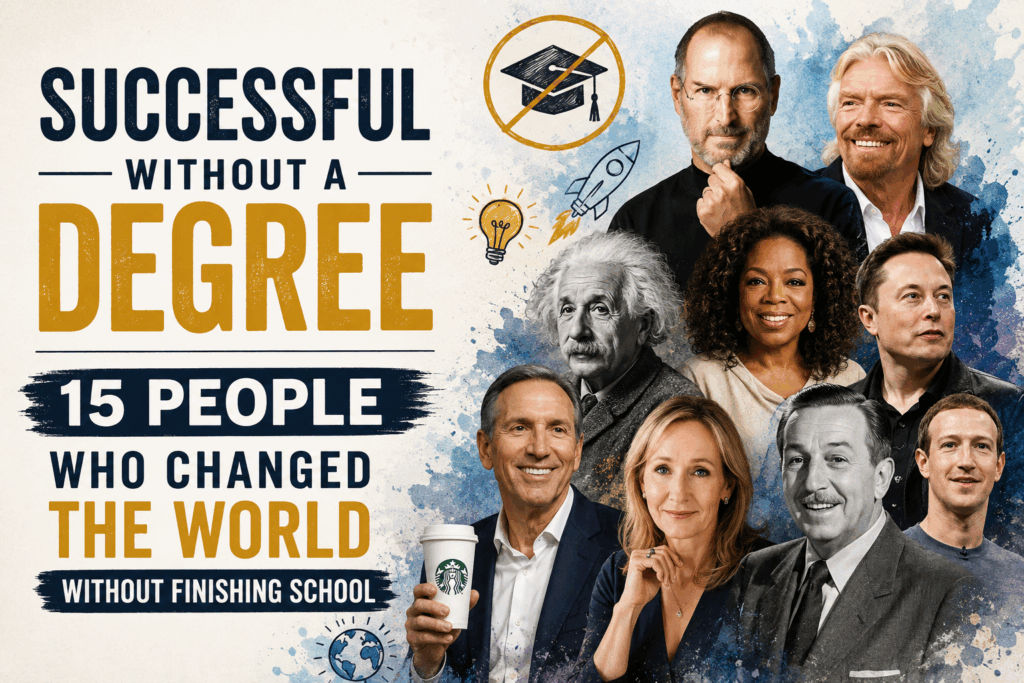
Here are 15 remarkable people who proved that success is not about where you studied. It is about what you are willing to build.
1. Bill Gates
Co-Founder of Microsoft
Net Worth: $104 Billion
Bill Gates enrolled at Harvard University in 1973, one of the most prestigious universities in the world.
He dropped out in 1975.
Why?
Because he saw an opportunity that could not wait.
He believed that personal computers would change the world and he was right.
Gates did not leave school because he was lazy or careless. He left because he had a vision so clear and so urgent that staying in a classroom felt like a detour from his real destination.
Microsoft became one of the most valuable companies in history.
The lesson:
Vision without waiting for permission is more powerful than credentials.
2. Steve Jobs
Co-Founder of Apple
Net Worth at death: $10 Billion
Steve Jobs dropped out of Reed College after just six months.
But he did not leave and do nothing.
He continued to attend classes that interested him, including a calligraphy course that later influenced the beautiful typography in Apple products.
Jobs believed deeply in following curiosity, not convention.
He went on to co-found Apple, Pixar, and NeXT, revolutionizing personal computing, animation, and mobile technology.
The lesson:
Curiosity and skill development matter more than formal completion.
3. Mark Zuckerberg
Co-Founder of Facebook (Meta)
Net Worth: $177 Billion
Mark Zuckerberg was a Harvard student when he launched Facebook from his dormitory room in 2004.
He dropped out the same year.
Today, Meta connects over 3 billion people worldwide.
Zuckerberg did not drop out because school was too hard.
He dropped out because what he was building was too important to delay.
The lesson:
When your vision is bigger than your classroom, act on it.
4. Richard Branson
Founder of Virgin Group
Net Worth: $3 Billion
Richard Branson struggled deeply in school.
He has dyslexia, a learning difficulty that made traditional education extremely challenging for him.
At 16, he dropped out of school entirely.
His headmaster told him he would either end up in prison or become a millionaire.
He became a billionaire.
Branson went on to build Virgin Group, a conglomerate of over 400 companies including airlines, music, telecommunications, and space travel.
The lesson:
Learning difficulties do not define your ceiling.
5. Oprah Winfrey
Media Mogul and Philanthropist
Net Worth: $2.5 Billion
Oprah Winfrey grew up in extreme poverty.
She faced abuse, trauma, and enormous hardship from childhood.
While she did attend Tennessee State University, her path to success was not built in a classroom.
It was built through raw talent, emotional intelligence, relentless work ethic, and an extraordinary ability to connect with people.
She became the first Black female billionaire in history.
The lesson:
Your background does not determine your future. Your drive does.
6. Ralph Lauren
Founder of Polo Ralph Lauren
Net Worth: $7 Billion
Ralph Lauren attended Baruch College in New York but dropped out after two years.
He worked as a sales assistant and used his creativity and vision to design a line of wide neckties that nobody was making at the time.
That small idea grew into one of the most iconic fashion empires in the world.
The lesson:
Spotting an opportunity others miss and acting on it creates empires.
7. Michael Dell
Founder of Dell Technologies
Net Worth: $50 Billion
Michael Dell enrolled at the University of Texas at Austin to study biology.
He dropped out at 19 to pursue his passion, building and selling personal computers.
He started Dell Technologies from his university dormitory room with just $1,000.
Today Dell is a global technology giant worth billions.
The lesson:
Starting small with real skill and real vision creates massive results.
8. Coco Chanel
Founder of Chanel
Net Worth at death: $160 Million (equivalent to billions today)
Coco Chanel grew up in an orphanage after her mother died and her father abandoned her.
She had almost no formal education.
But she had vision, creativity, and an extraordinary understanding of what women wanted to wear.
She revolutionized women’s fashion, liberating women from corsets and introducing timeless elegance to the world.
The Chanel brand today is worth over $13 billion.
The lesson:
Deep understanding of people’s needs and the skill to meet them builds lasting empires.
9. Henry Ford
Founder of Ford Motor Company
Net Worth at death: $200 Billion (adjusted)
Henry Ford had very little formal education.
He left school at 15 to work as a machinist apprentice.
But he was obsessed with mechanics, engineering, and solving problems.
He invented the moving assembly line, revolutionizing manufacturing and making the automobile accessible to ordinary people.
Ford changed the world not with a degree but with relentless curiosity and a desire to make people’s lives better.
The lesson:
Obsession with solving real problems is more powerful than academic achievement.
10. Walt Disney
Founder of The Walt Disney Company
Net Worth at death: $1 Billion (equivalent to $8 Billion today)
Walt Disney dropped out of high school at 16.
He was rejected multiple times.
He was told he lacked creativity.
His first animation company went bankrupt.
But he kept going.
He created Mickey Mouse, built Disneyland, and established one of the most beloved entertainment companies in human history.
The lesson:
Resilience in the face of repeated failure is what separates ordinary from legendary.
11. Amancio Ortega
Founder of Zara (Inditex)
Net Worth: $93 Billion
Amancio Ortega left school at 14 to work as a delivery boy for a shirt maker in Spain.
He learned the clothing business from the ground up.
He started making robes and housecoats from his living room.
Today Inditex, the parent company of Zara, is one of the largest fashion retailers in the world.
The lesson:
Learning through doing and starting from the bottom builds unshakeable expertise.
12. John D. Rockefeller
Founder of Standard Oil
Net Worth at death: $340 Billion (adjusted, richest person in modern history)
John D. Rockefeller never attended college.
He finished high school and took a short business course before entering the workforce at 16.
He built Standard Oil, the most dominant business empire of the 19th century, through discipline, strategic thinking, and an obsession with efficiency.
The lesson:
Strategic thinking and relentless discipline build wealth that transcends generations.
13. Andrew Carnegie
Founder of Carnegie Steel Company
Net Worth at death: $310 Billion (adjusted)
Andrew Carnegie immigrated to America from Scotland as a child.
He had almost no formal education.
He started working at 13 as a factory worker.
Through self-education, strategic relationships, and a burning ambition to add value, he built the largest steel empire in American history.
He later gave away over 90% of his wealth to libraries, universities, and education, believing deeply that knowledge should be accessible to everyone.
The lesson:
Self-education combined with ambition and generosity creates a legacy that outlives you.
14. Aliko Dangote
Founder of Dangote Group
Africa’s Richest Man
Net Worth: $13 Billion
Aliko Dangote did attend university, Al-Azhar University in Egypt where he studied business.
But his success was not built in a classroom.
It was built through bold entrepreneurship, strategic vision, calculated risk taking, and a deep commitment to adding value to Africa.
He started as a small trader and built the largest industrial conglomerate in Africa, producing cement, sugar, flour, and now oil.
He is living proof that education combined with vision, action, and discipline creates extraordinary results.
The lesson:
Education is a tool, not a guarantee. What you do with it determines everything.
15. Abraham Lincoln
16th President of the United States
Abraham Lincoln had less than one year of formal education.
He grew up in extreme poverty on the American frontier.
He taught himself to read.
He taught himself law.
He taught himself leadership.
He became one of the greatest presidents in American history, leading the nation through its most difficult period and abolishing slavery.
The lesson:
Self-discipline, self-education, and a commitment to a cause bigger than yourself changes history.
Conclusion
What do these 15 remarkable individuals have in common?
They did not wait for a certificate before they started adding value.
They did not wait for permission before they acted on their vision.
They did not allow the absence of a degree to become the absence of progress.
Each of them understood something profound:
Success is not about where you studied. It is about what you are willing to build.
They had skills and they developed those skills relentlessly.
They had vision and they pursued that vision courageously.
They had a desire to add value to others and they let that desire drive every decision they made.
Now, this is not an argument against education.
Education is powerful.
Knowledge is valuable.
Learning in any form is always worth pursuing.
But education without action produces nothing.
A degree without skill creates dependency.
A certificate without vision leads nowhere.
The real question is not whether you finished school.
The real question is whether you are adding value to the world.
Are you developing skills that help others?
Are you moving forward even when the path is uncertain?
Because in the end, the world does not reward certificates.
The world rewards value.
And value can be created by anyone, educated or not, who is willing to work, grow, learn, and give consistently.
Your background does not determine your destination.
Your daily decisions do.
So the question is not whether you have a degree.
The question is this:
What are you building today?
