

I want to tell you something that took me a while to fully understand: talent will get you noticed, but discipline is what keeps you in the room. Motivation will get you started, but consistency is what actually finishes the job. If you’ve ever wondered how to be disciplined and consistent, especially when life keeps throwing distractions your way, this post is for you.
I know that this may sound funny, but most people don’t fail because they lack ability. They fail because they start strong and fizzle out by week two. You’ve probably seen it happen to yourself. You wake up one morning fired up, you draw out a plan, you tell everyone about your new goal, and then two weeks later, that same fire has gone cold. If that’s you, don’t feel bad. It has happened to almost everyone at some point, myself included. The good news is that discipline and consistency are not personality traits you’re born with, they are skills you build, the same way you’d build a muscle.
Let’s talk about how.
1. Understand that discipline is a decision, not a feeling
One of the biggest lies we’ve been sold is that disciplined people always “feel like” doing the work. They don’t. Disciplined people have simply trained themselves to act regardless of how they feel on a particular day. If you wait to feel motivated before you show up, you will show up far less than you need to. Discipline means you decide once, ahead of time, and then you honor that decision even on the days your feelings disagree with you.
2. Start smaller than you think you should
This is where most people get it wrong. They set a goal that is far too ambitious for where they currently are, and by the third day, it feels impossible to keep up with, so they quit entirely. If you want to build consistency, start with something so small that skipping it would almost be embarrassing. Want to write daily? Start with one paragraph, not a whole article. Want to exercise? Start with ten minutes, not one hour. Small wins build the identity of someone who follows through, and that identity is what eventually carries the bigger goals.
3. Use systems, not just willpower
Willpower runs out, especially by the end of a long day, but a system doesn’t get tired. I personally rely on apps to help manage my own time and keep track of what I need to do, because I know that depending on memory or mood alone will fail me eventually. Set reminders, use a planner, batch your tasks, whatever works for you, but build a system around your goal so that discipline is not something you have to manufacture from scratch every single day.
4. Track your progress visibly
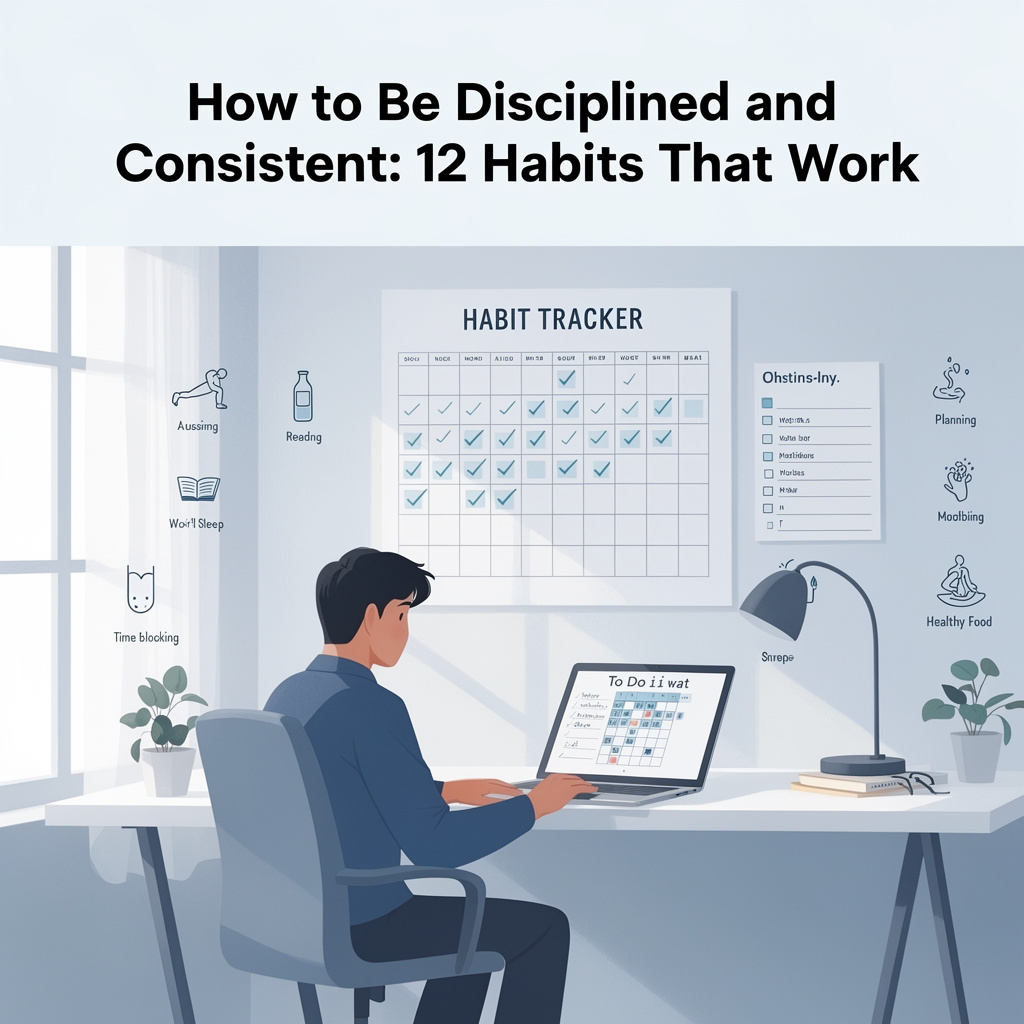
There’s something powerful about seeing your own consistency laid out in front of you. Whether it’s a habit tracker, a simple checklist, or crossing days off a calendar, seeing an unbroken chain of small wins tends to motivate you to protect that chain. Nobody wants to be the one who breaks their own streak. Use this to your advantage.
5. Expect resistance, and plan for it
Discipline is rarely tested on the good days, it’s tested on the days when you’re tired, discouraged, or when life throws something unexpected at you. If you don’t plan for those days in advance, you will use them as an excuse to quit. Decide ahead of time what your “minimum non-negotiable” looks like on a bad day. It should be small enough that you can still do it even at your lowest, because showing up in a small way is still infinitely better than not showing up at all.
6. Surround yourself with reminders of your why
When your reason for starting is strong and clearly in front of you, it becomes much easier to stay consistent, even when the excitement has worn off. Write down why you’re doing what you’re doing, and put it somewhere you’ll see often. On the days when discipline feels heavy, that reminder can pull you back to the reason you started in the first place.
7. Don’t aim for perfect, aim for repeatable
A lot of people abandon good habits because they missed one day and decided the whole thing was ruined. That’s the wrong way to think about consistency. Consistency was never about a flawless streak, it’s about how quickly you return after a slip. Missing a day doesn’t erase your progress, quitting does. Aim for a rhythm you can repeat for months and years, not a burst of intensity you can only sustain for a few days.
8. Get accountability from someone else
There’s a reason accountability works so well, it adds a layer of commitment that goes beyond your own willpower. Tell someone your goal, share your progress with them, or find a community of people working toward something similar. Knowing that someone else is watching, even gently, often gives you the extra push to stay consistent on days you’d otherwise let things slide.
9. Reduce the number of decisions you have to make each day
Discipline gets harder the more decisions you have to make about it. If you have to decide every single day whether you’ll write, exercise, or work on your goal, you’re giving yourself an exit every single day too. Instead, decide once, and turn it into a fixed part of your routine, the same way you don’t debate whether to brush your teeth each morning. When something becomes automatic, it stops requiring the same amount of discipline to maintain.
10. Remember that consistency compounds
The results of discipline are rarely visible in the first few days or weeks, and that is exactly why so many people give up too early. But just like a seed planted in the ground doesn’t sprout the next morning, your consistent effort is working underground before it ever shows up on the surface. Give your discipline enough time, and the results will eventually show up in a way that looks sudden to everyone watching, even though you know it was built quietly, day by day.
11. Rest on purpose, don’t collapse by accident
Some people lose their consistency not because they’re lazy, but because they never planned to rest, so their body and mind eventually forced a stop on them. Discipline is not the same as running yourself into the ground. Build rest into your routine the same way you build the work into it. A well-timed break protects your consistency, while an accidental burnout destroys it. There’s a difference between resting and quitting, and disciplined people know how to tell them apart.
12. Revisit and adjust your systems as you grow
The system that worked for you when you started may not be the one that serves you a year from now, and that’s completely normal. Discipline isn’t about rigidly sticking to a plan that no longer fits your life, it’s about staying committed to the goal while being willing to adjust the method. Check in with yourself regularly. Ask what’s working, what isn’t, and what needs to change. A disciplined person isn’t stubborn, they’re simply committed, and there’s a big difference between the two.
Why Discipline Matters More Than Motivation
Motivation is a wonderful spark, but it was never designed to be a fuel source. It comes and goes depending on your mood, your environment, even your sleep the night before. Discipline, on the other hand, is what keeps the fire burning long after the spark has faded. If you’re waiting to feel motivated before you take action, you may be waiting far longer than you can afford to. Build the discipline instead, and let the motivation catch up whenever it decides to show.
Final Thoughts
Discipline and consistency are not about being a different kind of person, they’re about building better systems and smaller, repeatable habits around the life you want to live. You don’t need to overhaul your entire life overnight, you only need to commit to showing up, especially on the days you don’t feel like it. Start small, protect your streak, plan for the hard days, and remind yourself often of the reason you began. Do this long enough, and consistency will no longer feel like a struggle, it will simply become who you are.
I say this often to people I mentor, and I’ll say it to you too: you don’t need to be the most talented person in the room to win in the long run, you only need to be the one who refuses to stop showing up. Talent without discipline eventually gets overtaken by mediocrity that never quits. Let that sink in, because it changes the way you look at every goal you’re chasing right now.
Conclusion
If there’s one thing to take away from this, it’s that discipline is built, not born, and consistency is proven in the small, unseen decisions you make daily, not in one big burst of effort. Every successful person you admire was once at the exact starting point you’re at now, the only difference is they kept showing up long after it stopped feeling exciting. Start small today, build your system, protect your streak, and trust that the compound effect of your discipline will eventually speak for itself.
Download free Goal Setting Worksheets for Personal Growth
